Internet of Things (IoT) - Scalable IoT platform for industrial monitoring and predictive maintenance

Internet of Things (IoT): Real-Time Industrial Monitoring Platform for Predictive Maintenance

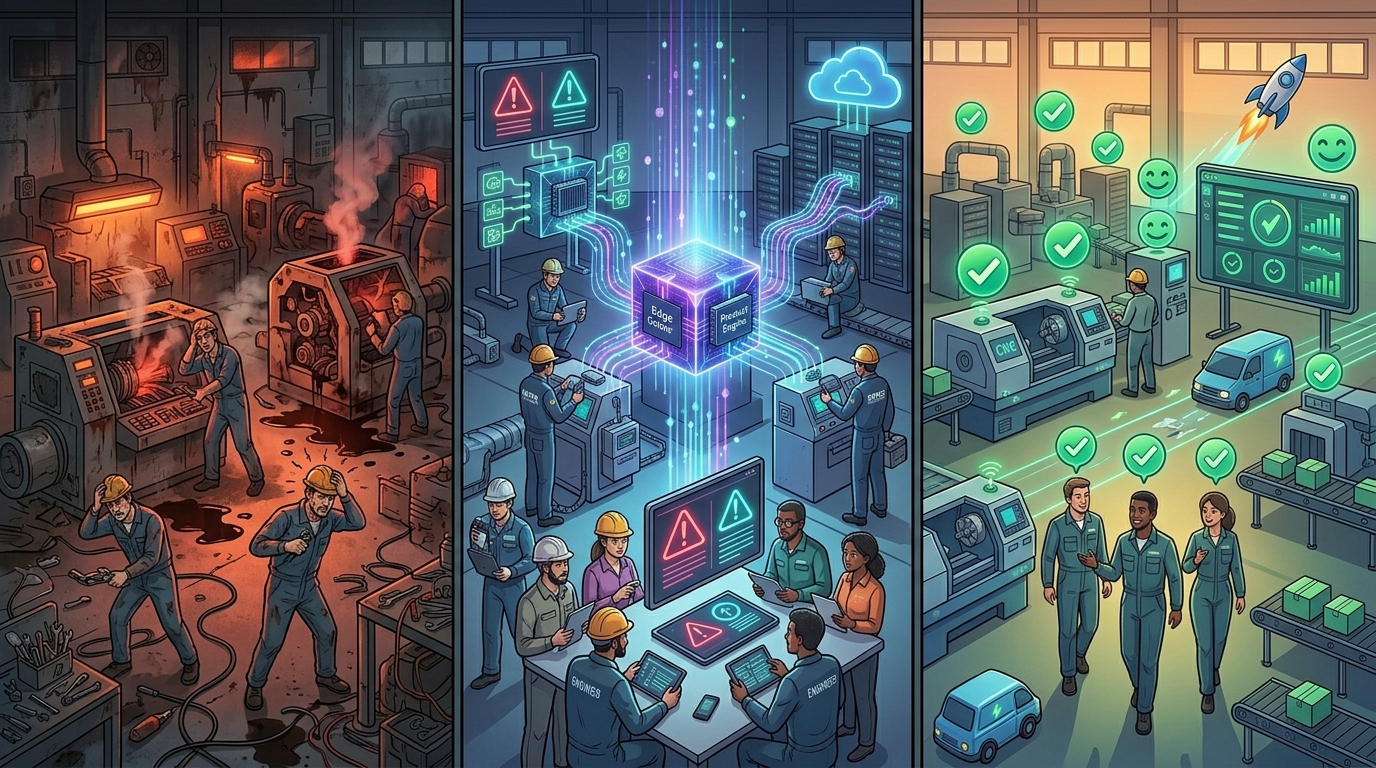
A global manufacturing company with 25 factories, 10,000+ machines, and $200M annual maintenance costs faced massive unplanned downtime due to reactive maintenance strategies — each hour of production loss costing $500,000. Spundan designed and deployed an end-to-end IoT platform connecting 15,000+ industrial sensors, processing 500M+ daily data points, and delivering real-time machine health monitoring with AI-powered predictive maintenance. The platform reduced unplanned downtime by 67%, cut maintenance costs by 45%, and delivered $85M in annual savings.

The Challenge

The manufacturing company was operating with fragmented, reactive maintenance processes that cost millions in downtime and emergency repairs:

The Solution: End-to-End Industrial IoT Platform

Spundan architected and deployed a comprehensive IoT platform spanning edge devices to cloud analytics, enabling real-time monitoring and predictive maintenance:

  1. Edge Gateway Layer: Deployed industrial edge gateways at each factory aggregating data from 50+ machine types and protocols (OPC-UA, Modbus, MQTT, Profibus) — normalizing data into unified schemas at the edge.
  2. Ingestion Pipeline: Built Kafka-based ingestion layer handling 500M+ daily sensor readings with sub-second latency, exactly-once processing, and 12-month data retention policy.
  3. Time-Series Database: Implemented TimescaleDB (PostgreSQL-based) for efficient storage and querying of high-velocity sensor data — supporting real-time dashboards and historical analysis.
  4. Digital Twin Models: Created digital twin representations for 15 major machine types, modeling normal operating parameters, failure modes, and degradation patterns based on OEM specifications and historical data.
  5. Predictive Analytics Engine: Built ML pipelines (anomaly detection, remaining useful life prediction, failure classification) using XGBoost and LSTM networks — trained on 3 years of historical sensor and maintenance data.
  6. Real-Time Monitoring Dashboard: Developed React-based dashboards showing live machine health, alerts, MTBF trends, and recommended actions — accessible from factory floor displays and mobile devices.
  7. Alert & Workflow System: Implemented tiered alerting (predictive warning, imminent failure, critical failure) with automated work order creation in existing CMMS system — reducing human latency in response.
  8. Edge AI for Low-Latency Decisions: Deployed lightweight ML models on edge gateways for real-time anomaly detection where sub-second response was critical (e.g., vibration spikes indicating bearing failure).

Implementation Steps

The IoT platform was rolled out incrementally across factories, starting with pilot machines and expanding based on proven ROI:

Results

The IoT platform transformed the company's maintenance operations, delivering dramatic reductions in downtime, costs, and emergency repairs:

Conclusion

The Industrial IoT platform demonstrated that connecting machines, collecting data, and applying predictive analytics can fundamentally transform manufacturing operations. By moving from reactive firefighting to proactive, data-driven maintenance, the company eliminated millions in downtime costs, extended equipment life, and empowered their maintenance teams with actionable intelligence. The platform now serves as the foundation for broader Industry 4.0 initiatives, including quality prediction, energy optimization, and automated production scheduling. Most importantly, the IoT data infrastructure enabled new business models — the company now offers equipment-as-a-service to customers, with uptime guarantees backed by real-time monitoring and predictive maintenance capabilities.