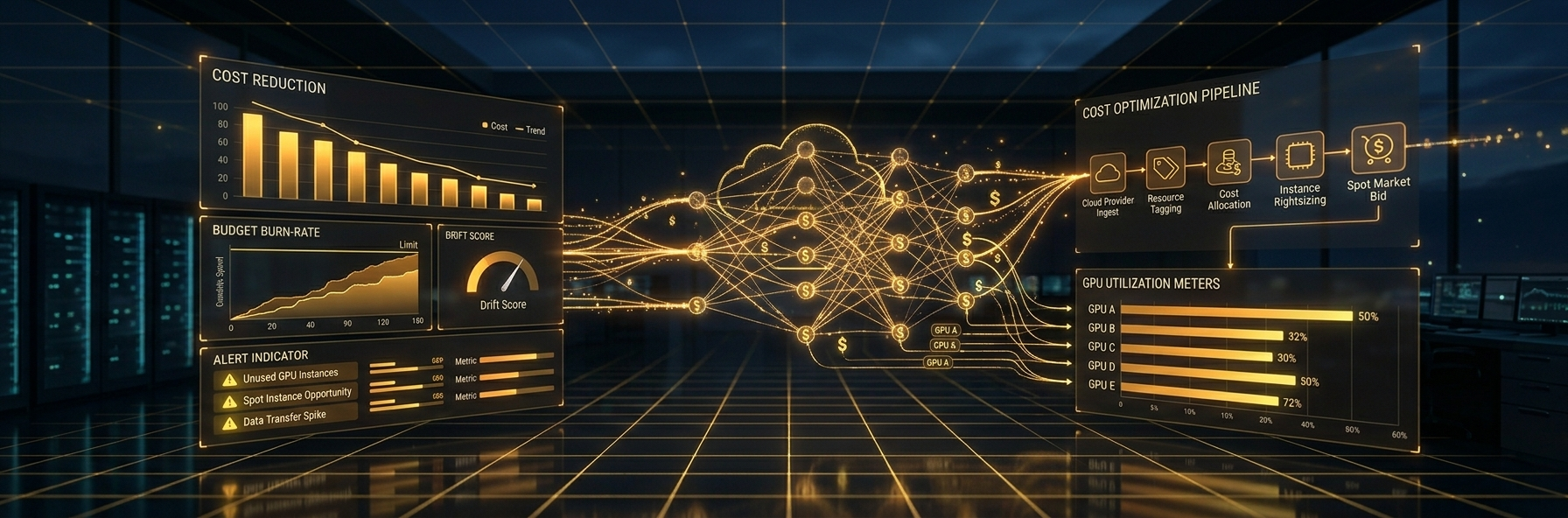
FinOps for AI: Cutting Cloud AI Spend Without Slowing Innovation
A fast-growing SaaS company scaling its AI and machine learning
capabilities saw cloud costs spiral out of control — GPU bills
tripling year-over-year with no clear ownership or optimization
strategy. Spundan implemented a full FinOps for AI framework that
brought complete cost visibility, accountability, and automated spend
governance across every AI workload, slashing infrastructure costs
while accelerating the pace of model delivery.
The Challenge
As AI adoption expanded rapidly across product, data science, and
research teams, cloud spending became a serious operational and
financial risk:
GPU and TPU cloud costs grew by over 200% year-on-year with no
corresponding ROI tracking
No cost attribution — teams had no visibility into which models,
experiments, or pipelines were driving spend
Idle and over-provisioned GPU instances running 24/7, wasting
significant budget
Redundant model training runs due to lack of experiment tracking and
result sharing
No budget alerts or guardrails — teams discovered overspend only at
month-end billing
Data science and engineering teams operated in silos, with no shared
cost accountability
Shadow AI workloads launched outside approved cloud accounts,
invisible to finance
Inability to forecast AI infrastructure costs, making annual budget
planning unreliable
The Solution: A FinOps for AI Framework Across the Entire ML Lifecycle
Spundan designed and deployed a FinOps operating model purpose-built for
AI workloads, spanning cost visibility, governance, optimization, and
cultural accountability. Key strategic components included:
AI Cost Attribution & Tagging: Implemented granular
resource tagging across all cloud accounts — attributing every GPU
hour, storage byte, and API call to a specific team, project, model,
or experiment.
Unified Cost Observability Dashboard: Built a
real-time spend dashboard surfacing per-team, per-model, and
per-pipeline costs with trend analysis, anomaly detection, and budget
burn-rate forecasting.
Automated Idle Resource Termination: Deployed
policies to automatically shut down idle GPU instances, orphaned
notebooks, and stale training jobs after configurable inactivity
thresholds.
Spot & Preemptible Instance Optimization: Migrated
fault-tolerant training workloads to spot/preemptible instances, with
automated checkpointing to handle interruptions without losing
training progress.
Experiment Deduplication & Caching: Integrated
MLflow-based experiment tracking to surface similar past runs,
preventing redundant training and enabling result reuse across teams.
Budget Guardrails & Real-Time Alerts: Configured
proactive budget thresholds with automated alerts to Slack and email
at 50%, 80%, and 100% of monthly budgets per team and project.
FinOps Culture & Showback/Chargeback: Established a
FinOps guild, introduced showback reports to engineering leads, and
implemented chargeback models to create genuine cost ownership within
teams.
Implementation Steps
The FinOps for AI program was delivered in structured phases, balancing
quick wins with long-term cost governance maturity:
Cloud Spend Audit: Conducted a full audit of all
active cloud accounts, identifying untagged resources, idle compute,
orphaned storage, and shadow workloads across AWS, GCP, and Azure.
Tagging Taxonomy Design: Defined a standardized
tagging schema covering team, project, environment, model name, and
cost center — enforced via cloud policy and CI/CD pipeline gates.
Observability Stack Setup: Deployed a cost
observability stack integrating AWS Cost Explorer, GCP Billing Export,
and Azure Cost Management into a unified Grafana dashboard with custom
AI workload views.
Idle Resource Policies: Wrote and deployed
cloud-native automation scripts (Lambda, Cloud Functions) to detect
and terminate idle GPU instances, notebooks, and long-running jobs
exceeding defined thresholds.
Spot Instance Migration: Profiled all training
workloads for interruption-tolerance, migrated eligible jobs to
spot/preemptible instances, and integrated automatic checkpointing via
MLflow and cloud-native checkpoint APIs.
Experiment Tracking Integration: Standardized MLflow
adoption across all teams, enabling experiment deduplication, model
artifact reuse, and cross-team result sharing to eliminate redundant
training runs.
Budget & Alert Configuration: Set up granular budget
alerts per team, project, and environment; configured anomaly
detection for unusual spend spikes routed to team leads and the FinOps
guild.
Showback Reporting & Training: Launched monthly
showback reports for all engineering leads, conducted FinOps awareness
workshops, and embedded cost review into sprint retrospectives and
model release checklists.
Results
The FinOps for AI program delivered significant, measurable savings and
instilled a lasting culture of cost accountability across the
organization:
Total Cloud Cost Reduction: Achieved a
42% reduction in total AI infrastructure spend within the first
six months of implementation.
GPU Utilization Improvement: Average GPU utilization
across the fleet increased from 34% to 81% through idle
termination and workload right-sizing.
Spot Instance Savings: Migration of eligible training
workloads to spot instances delivered an additional
60% cost reduction on compute for those jobs.
Eliminated Redundant Training: Experiment
deduplication and result caching reduced redundant model training runs
by 35%, saving both time and budget.
Full Cost Visibility: Achieved
100% tagged resource coverage within 60 days, giving finance
and engineering complete, real-time visibility into AI spend by team
and project.
Proactive Budget Control: Budget overruns dropped to
zero in the quarter following alert and guardrail deployment,
compared to three significant overruns in the prior quarter.
Faster Model Delivery: Paradoxically, model training
turnaround improved by 25% as teams leveraged cached
experiments, right-sized instances, and eliminated wasted queuing time
from over-provisioning.
Conclusion
The FinOps for AI engagement proved that cost discipline and innovation
velocity are not opposing forces — when done right, they reinforce each
other. By bringing full visibility, automated governance, and a culture
of cost ownership to every AI workload, the organization cut its cloud
AI spend by 42% while simultaneously delivering models faster. The
FinOps framework now serves as a permanent operating capability, scaling
alongside the company's growing AI ambitions and ensuring that every GPU
dollar spent delivers measurable business value.