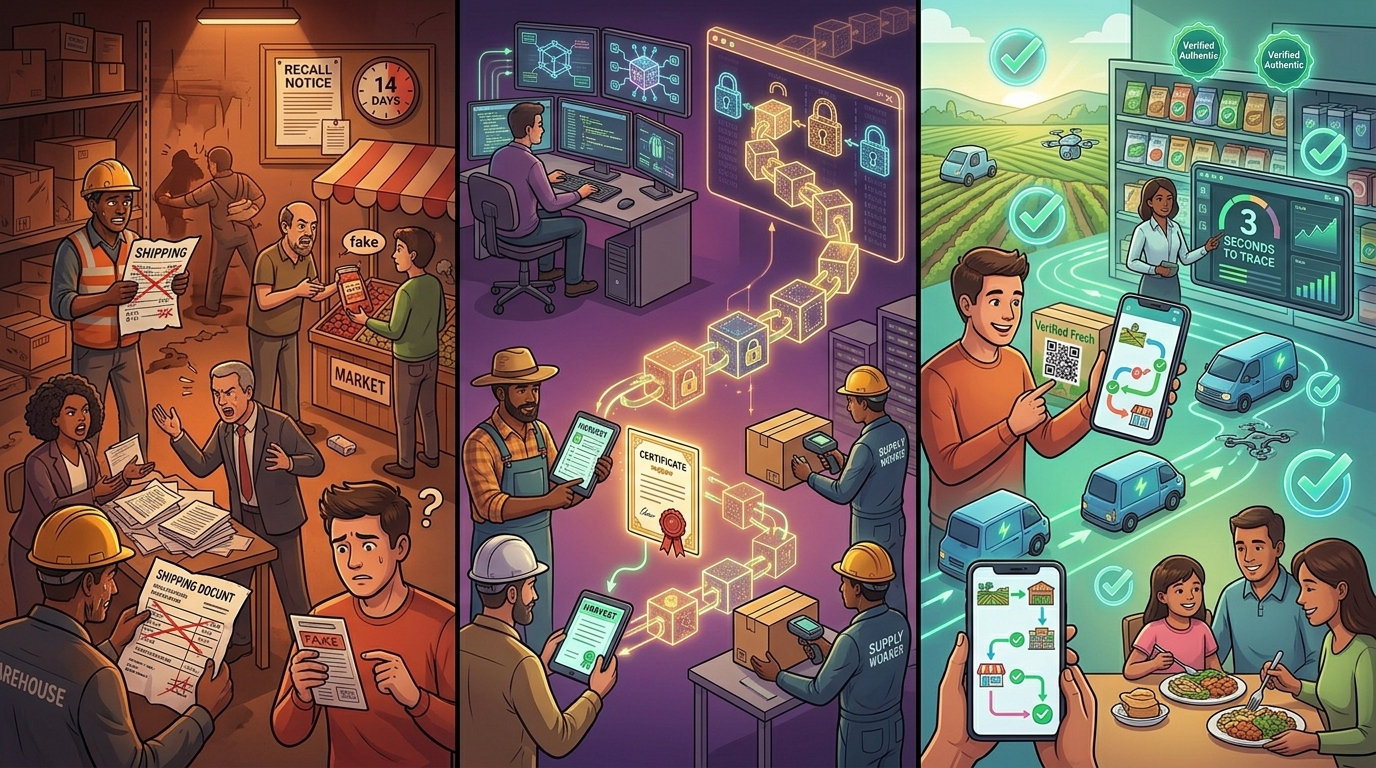
Blockchain Integration - Enterprise blockchain for supply chain traceability and smart contracts

Blockchain Integration: Immutable Supply Chain Traceability from Farm to Fork

A global food and beverage conglomerate with $15B annual revenue faced a mounting crisis — counterfeit products entering their supply chain, weeks-long recall investigations, and growing consumer demand for transparent provenance. Each counterfeit incident cost $10M+ in brand damage, and regulatory recalls took 14+ days to trace from store shelves back to source. Spundan built an enterprise blockchain platform using Hyperledger Fabric, connecting 500+ suppliers, manufacturers, distributors, and retailers into a single source of truth. The platform reduced investigation time from 14 days to 3 seconds, eliminated counterfeit products entirely, and increased consumer trust scores by 42%.

The Challenge

The food and beverage company was losing millions to supply chain opacity, counterfeit products, and slow recall processes:

The Solution: Enterprise Blockchain for End-to-End Traceability

Spundan designed and deployed a permissioned blockchain network providing immutable, shared visibility across the entire supply chain:

  1. Permissioned Blockchain Network: Deployed Hyperledger Fabric with 8 organizations (suppliers, manufacturers, distributors, retailers, certifiers, regulators) as network peers — each maintaining a copy of the immutable ledger.
  2. Unique Product Identifiers: Assigned GS1-compliant serialized identifiers (EPCIS standards) to each batch and individual high-value product — enabling item-level traceability from raw material to retail shelf.
  3. Smart Contract Workflows: Implemented chaincode for automated event recording at each supply chain step — harvest, processing, packaging, shipping, receiving, shelving — with cryptographic signatures from each participant.
  4. IoT Integration: Connected IoT sensors (temperature, humidity, GPS) that automatically record environmental conditions to the blockchain — ensuring cold chain compliance with tamper-proof logs.
  5. Certificate Management: Digitized all certifications (organic, fair trade, kosher, halal) as verifiable credentials on blockchain — enabling instant authenticity verification by any network participant.
  6. Recall Automation: Built smart contract that, when a contamination source is identified, automatically traces all affected batches, notifies all downstream partners, and triggers recall workflows within seconds.
  7. Consumer Portal: Developed QR code scan interface allowing consumers to view complete product journey — from farm origin, processing dates, certifications, to current location — building trust and transparency.
  8. Privacy Controls: Implemented channel-based data isolation and private data collections — competitors see only relevant transaction data while sensitive business information remains confidential.

Implementation Steps

The blockchain platform was built incrementally, starting with high-value product lines and expanding to full supply chain coverage:

Results

The blockchain platform delivered transformative improvements in traceability, recall speed, counterfeiting prevention, and consumer trust:

Conclusion

The blockchain integration proved that distributed ledger technology is not just for cryptocurrency — it's a powerful tool for enterprise supply chain transparency. By creating an immutable, shared record of every product movement, the food and beverage company eliminated information asymmetry across their supply network, enabling trust without intermediaries. The platform delivers value daily: millions of consumers scan QR codes to see their product's journey, supply chain partners reconcile shipments instantly on shared ledgers, and regulators receive tamper-proof audit trails during inspections. Most importantly, when contamination occurs, the company now protects consumers within hours instead of weeks — fulfilling the ultimate promise of traceability: safety through transparency.