The Solution: An End-to-End AI Model Observability Platform
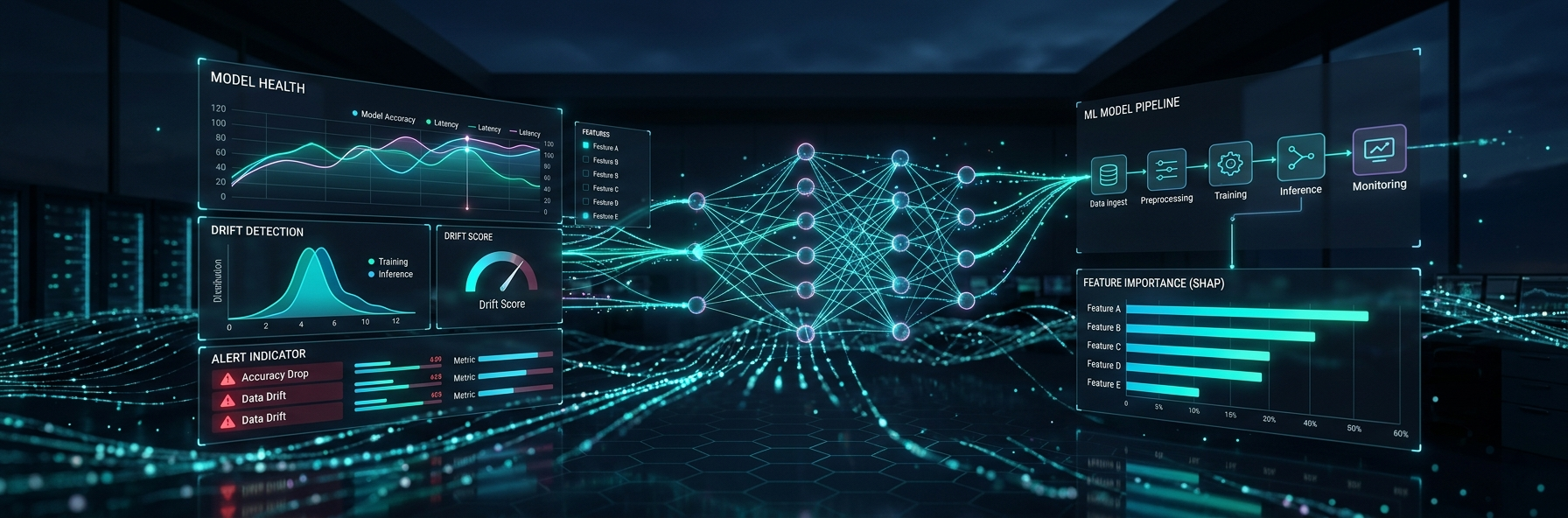
Spundan designed and deployed a unified observability layer that wraps all production ML models
with monitoring, explainability, and governance capabilities. Key strategic components included:
-
Real-Time Performance Monitoring: Continuously tracked accuracy, precision,
recall, F1, and business KPIs for every model in production via live dashboards.
-
Data & Concept Drift Detection: Automated statistical tests (PSI, KS, Chi-Square)
on input features and output distributions to detect drift before it degrades predictions.
-
Data Quality Monitoring: Schema validation, null-rate checks, and outlier
detection on incoming data pipelines to catch upstream data issues at ingestion.
-
Explainability & Fairness Dashboards: Integrated SHAP and LIME for
feature-level explanations per prediction, with fairness metrics across demographic segments.
-
Automated Alerting & Retraining Triggers: Configured threshold-based and
anomaly-based alerts routed to Slack and PagerDuty, with automated retraining pipeline triggers.
-
Model Governance & Audit Trails: Every prediction, model version, and
data snapshot logged to an immutable audit store for regulatory review and compliance reporting.
-
Unified Observability Hub: A single pane of glass across all model types
(classification, regression, NLP, LLMs) and all teams — data science, MLOps, risk, and compliance.
Results
The AI Model Observability platform delivered measurable gains across model reliability,
operational efficiency, and regulatory confidence:
-
Earlier Drift Detection: Reduced average time to detect model drift from
6 weeks to under 48 hours, preventing downstream business impact.
-
Prediction Accuracy Maintained: Model accuracy degradation incidents dropped
by 65% year-on-year due to proactive retraining triggers.
-
Regulatory Compliance: Achieved 100% audit trail coverage across all
production models, satisfying internal audit and external regulatory reviews without manual
evidence gathering.
-
Faster Incident Resolution: Mean time to resolve model-related incidents
dropped by 72% through automated alerting and runbook-guided responses.
-
Data Science Productivity: Data scientists reclaimed 40% of their time
previously spent on manual model health checks, redirecting effort to feature engineering and
new model development.
-
Retraining Cost Reduction: Data-driven retraining schedules reduced
unnecessary retraining runs by 35%, lowering compute costs significantly.
-
Explainability at Scale: Business and risk teams gained on-demand SHAP-based
explanations for any prediction, building trust in AI-driven decisions across the organization.
Conclusion
The AI Model Observability platform transformed how the organization manages its production ML
estate — shifting from reactive firefighting to proactive, data-driven model governance.
By providing real-time drift detection, explainability, and an immutable audit trail, the
solution restored confidence in AI-driven decisions and freed data science teams to innovate
rather than monitor. The unified observability hub now serves as the foundation for responsible
AI operations, enabling the business to scale its model portfolio with full visibility,
compliance assurance, and operational resilience.